Care. Curiosity.
Independence.
An educational philosophy grounded in safe practice, original visual expression and a sustainable creative life.
Nail artistry is a form of applied art. It brings design, colour, material and touch into a deeply personal space. A strong practice demands more than keeping up with a trend: it asks for care, technical judgement, curiosity and a point of view.
The Independent Nail Artist is designed as a pathway from foundational knowledge to an original creative practice. We teach the discipline as four intertwined movements: the craft that protects the client; the art that gives the work meaning; the artist who develops a distinct voice; and the business that makes independence possible.
Success is not defined by a certificate or a promise of income. It is demonstrated by safe practice, repeatable skill, thoughtful creative choices, honest presentation and a credible plan for serving real clients.
The learning philosophy.
Learning begins with understanding, develops through deliberate practice, and deepens through critique. Every course connects a principle to an exercise, an assessed outcome and a portfolio artefact.
Care before speed.
Safety, client consent and the integrity of the natural nail take precedence over completion time or appearance.
Practice with intent.
Repeat a skill with a specific improvement target. Record outcomes and review the difference, rather than count repetition alone.
Originality through study.
Study art, culture and fashion with attribution; transform references into work that expresses your own judgement.
Independence with integrity.
Present work truthfully, price transparently, respect limits and grow only when competence and systems support it.
The learning cycle
- Understand the principle and its limits.
- Observe a qualified demonstration where technical work is involved.
- Practise on a suitable training surface.
- Apply to an original brief or simulated service.
- Receive specific critique and correct errors.
- Document results and reflect on the next improvement.
| Learning mode | Suggested share |
|---|---|
| Practical craftsmanship | 50% |
| Creative projects | 20% |
| Theory & demonstrations | 15% |
| Business development | 10% |
| Critique & reflection | 5% |
Safety before everything.
This chapter gives educational safety principles, not medical advice or a substitute for professional instruction. Nail professionals must not diagnose or treat nail disease. Seek qualified guidance and follow local health, licensing, occupational and waste requirements.
Before a service
- Obtain informed consent, review relevant allergies and ask about symptoms or previous reactions.
- Defer and refer for suspected infection, unexplained nail changes, inflammation, pain, damaged skin or a previous adverse reaction.
- Prepare a clean workstation; wash hands; separate clean and used equipment.
- Check product labels, safety data sheets, compatible systems and the intended curing or removal instructions.
During and after
- Prevent uncured gel or reactive product from contacting skin; follow product-specific controls and lamp instructions.
- Use suitable local extraction and ventilation, avoid unnecessary dust and vapour exposure, and follow the SDS for protective equipment.
- Avoid cutting the protective cuticle or aggressive filing. Stop if there is pain, injury, irritation or another concerning symptom.
- Clean and disinfect reusable instruments using validated methods and required contact times; sterilise where local rules or instrument use require it. Discard single-use items safely. A UV storage box is not a replacement for disinfection.
- Provide product-specific aftercare and advise medical review for concerning reactions. Document incidents and follow local exposure and reporting procedures.
Further reading: OSHA nail salon safety (chemical and biological hazards), FDA nail care products and CDC nail hygiene. See the source directory in Chapter 13; these US resources are general references, not jurisdiction-specific law.
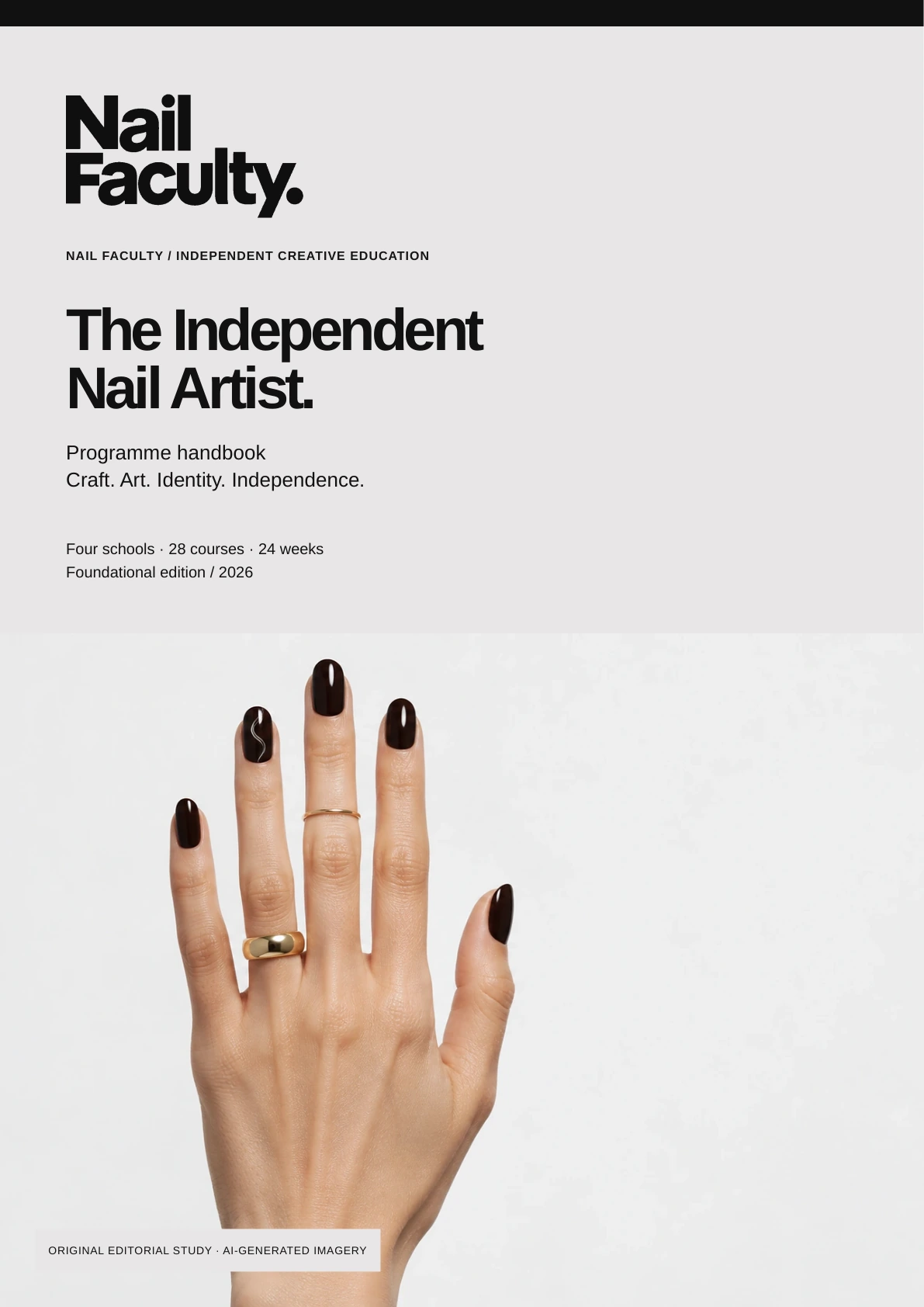
A handbook for your creative future.
Explore the complete programme, all 28 course specifications, practical assignments, assessment standards and the path to an independent practice. Read online or keep the printable edition.